Blog

Juno title sequence

2.29.2008 | blog, Media, Movies

Watched this movie over previous weekend and the title sequence left a big impression on me. I have been hunting for this sequence online to share with you all. At last here it is…

j01
It’s a lo-fi animation sequence in which the teen of the title strolls pensively through her neighbourhood, chug-a-lugging a jug of SunnyD in preparation for a pregnancy test. With cut-out Xerox images of Ellen Page, hand-drawn typography and a whimsical tune by kids’ balladeer Barry Louis Polisar on the soundtrack, it immediately tells us this is going to be a sweet, funny-sad film with an indie spirit.

And, of course, it is.

j02

Year of production: 2007
Film director: Jason Reitman
Title designer: Shadowplay Studio

Other credits
Title designers: Gareth Smith & Jenny Lee,
Title sequence producer: Ari Sachter-Zeltzer,
Music: “All I Want is You” by Barry Louis Polisar

Watch it here

Hailed by many as one of the most memorable recent title sequences. Title designer Gareth Smith talks about the process of creating the title sequence.

“The Juno opening title sequence was truly a labor of love for all of us at Shadowplay Studio. It took nearly supernatural patience in order to get through the main task involved in the creation of the title sequence: the printing, hand-tracing, xeroxing, cutting and coloring of over 900 images of Juno walking through her neighborhood. But we had a fantastic time working on the project and were glad to be working with our hands instead of the computer.”

Shadowplay Studio worked with director Jason Reitman before on Thank You For Smoking, which is still one of the most viewed title sequences on Forget the Film, Watch the Titles. Reitman, who says he’s a “big fan” of opening credits, brought the designers in on the project very shortly after he signed on to direct Juno.

“When we first met with Jason about it, he played some of the music he was thinking of using in the soundtrack, including Kimya Dawson’s songs with the Moldy Peaches. This music, the tone and originality of the screenplay, and the uniqueness of Juno’s character, led us down the path toward creating a low-fi, hand-animated title sequence.”

“We wanted to create something that had texture and a little bit of edge, but also imparted the warmth and heart of the screenplay.”

“Jason also let us know that he wanted the opening title sequence to take place after the first scene of the film – the scene in which Juno is admiring a discarded living room set on a lawn. Because we were able to start the process of designing the title sequence before the film was actually shot, it allowed us to create something that integrated very nicely into the story-line of the film. It seemed natural to show the credits while the audience followed Juno from the opening scene, through her neighborhood, and to the convenience store where she gets her pregnancy test.”

“This decision allowed us to do something a little unusual for an opening title sequence: focus the sequence entirely on the main character of the film. This allowed the audience to really get a sense of, and get immersed in, Juno’s unique, quirky point of view of the world.”

“We flew up to Vancouver during the final week of shooting the film, and were able to get some time with Ellen Page and Jason the day after they finished shooting the movie. We shot thousands of photos of Ellen walking on a treadmill with a high-speed camera from a number of angles. Jason had a guitar with him and strummed out some chords to help get her in the right mind-set.”

“We then took these photos back to our studio and edited together a rough animatic which allowed us to figure out the timing and shot selection for the final title sequence. When we had something that everyone was happy with, we began the laborious process of hand-creating the title sequence.”

“Every element that appears in the title sequence was hand-made, including the typography. We used the computer to save us a tremendous amount of time to layer the elements together, but tried as best as possible to adhere to the idea of mimicking the limitations of shooting stop-motion animation from a real-world copy stand.”

“To create the cut-outs of Juno, we printed every frame, outlined Juno, then photo-copied the prints several times to degrade the quality. Each of these frames were then hand-colored and cut out with scissors. This is a process that we’ve been wanting to try out for quite a while, and this project seemed like the perfect opportunity to do it.”

“Toward the end of production process, we were asked to create the hand-animated season title cards that appear in the film, as well as the end titles, which we created a custom typeface for. After the film was released, we were invited to collaborate on the design of the music soundtrack and contribute drawings and cut-outs for the dvd.”

“Despite the massive amount of time it took to pull this off, we were happy to be working on it every time we picked up a pen or a pair of scissors. Jason Reitman’s constant enthusiasm and positive energy inspired us throughout the production process, and we are proud to have been involved with this film.”

Here are some images of the process of creating this striking title sequence, makes you realize that you dont have to necessarily need eye-candy CGI to create a memorable graphics.

j03
j04
j05
j06
j07

j08

j09

Tags: ,


Lord of War title sequence

6.27.2007 | blog, Media, Movies

Lord of War title sequence

Lord of War title sequence

Lord of War starring Nicolas Cage features an incredible title sequence that of a journey of a bullet from the arms factory to the guerilla rebels in Africa. An interesting study in live and CG compositing and HDRI reflection.

L’E.S.T. visual effects supervisor Yann Blondel talks about the digital techniques he employed for key sequences in Lord of War opening ‘bullet factory’ titles

At the beginning of the sequence we dive on a machine. This machine has been created/extended using CGI and some animation has been added to it. That shot had also been accelerated and stabilised.

Inside the machinery everything is CGI until we emerge on the conveyor belt.

ot010_1

The conveyor belt itself is CGI and the bullets are as well. The background needed to be reconstructed in CGI because the camera was waving a little too much and we wanted a straight trajectory. When the bullet is picked up, the actor and the hand have been shot against green screen and composited on a CGI background.

ot010_2
After being tossed back on the conveyor belt we fall in a tube. Here, again, everything is CGI until we fall in the crate full of bullets (which is obviously CGI).

ot010_3

We emerge on the second conveyor belt. The background has been retimed and stabilized. Here only the foreground is CGI. It’s exactly the same case when the crate is opened in the Ukrainian Harbor.

ot010_4

ot010_5

When the crate is opened again in Africa it’s another story. When the bullet falls and rolls on the ground everything is CGI. We had shot a nice movement but the distance with the ground wasn’t good. We had to recreate the whole background in CGI to gain a couple of inches! And as there were moving elements it wasn’t simple.

ot010_6

Then the bullet is tossed in another crate full of ammunitions (all CGI). While being loaded into the truck and travelling through the jungle the crate and the bullets are CGI.

ot010_7

In the street, until we get thrown on the ground, only the crates and the bullets are CGI. But when we get loaded in the magazine everything is CGI from background to the magazine and the barrel of the AK47.

ot010_8

And then, when the bullet is shot we only added a CGI bullet, some guys fighting in the street, accelerated and stabilized the shot.

Software details:
XSI, Shake, After Effects, Photoshop and Matchmover for 3D tracking.

VFX:
L’E.S.T. (visit the link for some major vfx shot breakdowns and stuff.

Watch and Download it here

\m/

Tags: ,


Saul Bass: Hollywood’s man behind the title

3.01.2007 | blog, Movies

Image

Saul Bass (May 8, 1920 – April 25, 1996) was a graphic designer and Academy Award-winning filmmaker, but he is best known for his design on animated motion picture title sequences, which is thought of as the best such work ever seen.

During his 40-year career he worked for some of Hollywood’s greatest filmmakers, including most notably Alfred Hitchcock, Otto Preminger, Stanley Kubrick and Martin Scorsese.

His most famous title sequence is probably the animated paper cut-out of a heroin addict’s arm for Preminger’s The Man with the Golden Arm.

Saul Bass designed the 6th AT&T Bell System logo, that at one point achieved a 93 percent recognition rate in the United States. He also designed the AT&T “globe” logo for AT&T after the break up of the Bell System.

Hollywood’s man behind the title
Movies never started the same after Saul Bass made a mark with bold, symbolic sequences.

By Susan King, Times Staff Writer

DURING the classic studio era in Hollywood, movie title sequences were generic.

“Every studio had its own look,” says film historian Jan-Christopher Horak. “They did [titles] the same way; just the names changed.”

But when the studio system started to wane in the 1950s, title designs began to evolve. “They started doing more inventive things,” says Horak. “The film begins over the titles or you have an open book and the pages will be turning.”

That was a start, but Saul Bass took the form to an entirely different level. A true pioneer, he turned movie opening and closing title sequences on their ear with bold, graphically vivid designs. His title sequences would often resemble an animated film.

“Like the good designer that he was, he would come up with some kind of iconic symbol to encapsulate what the movie is about,” says Horak. In Bass’ design for Otto Preminger’s 1960 epic “Exodus,” the symbol is an arm holding up a gun. For Preminger’s 1958 romantic drama “Bonjour Tristesse,” it’s an exaggerated tear dripping down the face of a young woman.

Bass’ posters, soundtrack album covers and storyboards for the “Psycho” shower sequence ? Bass drew the storyboards for director Alfred Hitchcock for the iconic scene ? plus screenings of a montage of film titles edited by Bass and his wife Elaine are currently on display at the Skirball Cultural Center.

“Saul Bass: The Hollywood Connection,” which was developed with the curatorial guidance of the Academy of Motion Picture Arts and Sciences, also features screenings of his Oscar-winning 1968 short, “Why Man Creates.” And on select Tuesday afternoons this month and in February, the Skirball will screen films for which he designed the titles and the posters.

Born in New York City in 1920, Bass studied at the Art Students League in Manhattan before attending Brooklyn College. “He came out to California in 1948 and starts doing print ads for movies, though he didn’t get credit,” says Horak.

Bass’ first big break came when he collaborated with Preminger on the 1954 film “Carmen Jones.” Preminger was so impressed with his poster design for the film, he asked Bass to create the opening and closing titles.

Bass gained acclaim for his designs for Preminger’s classic “The Man With the Golden Arm,” the director’s 1955 drama about a jazz musician (Frank Sinatra) struggling to overcome heroin addiction. He selected a black-and-white cutout arm as the central image of the poster and the opening title design.

He continued to work with Preminger into the 1970s, as well as providing startling designs for Alfred Hitchcock’s “Vertigo,” “North by Northwest” and “Psycho” and working with Billy Wilder on such films as “One, Two, Three.”

Still, says Horak, “most of his money he made doing other things. He designed a lot of famous corporate logos ? for example, the Bell telephone logo. He would get paid millions for just [the logo].”

Bass started doing more and more corporate work in the 1970s and ’80s. “From what I’ve heard, he priced himself [out of the movie] market,” says Horak. “He wanted too much money for what he was doing.”

That is until Martin Scorsese hired him to create the title designs for “GoodFellas,” “Cape Fear,” “The Age of Innocence” and “Casino.”

Bass died in 1996, but his popularity continues. Horak says his posters “really stand out because they are so interesting as graphic designs. For that reason, they have become highly collectible.”

Image
Carmen Jones: the Title Credits

Image
Schindler’s List poster (not used for the final movie)

Image
Around the World in 80 Days: the Title Credits

Image
Anatomy of a Murder: the Title Credits

Image
Spartacus: the Title Credits

Image
West Side Story: the End Credits

Image
The Cardinal: the Title Credits

Image
Seconds: the Title Credits

Image
Cape Fear: the Title Credits

Image
The Seven Year Itch: the Title Credits

Image
Bonjour Tristesse: the Title Credits

Image
North by Northwest: the Title Credits
*freakin’ amazing if you consider the time it was made!

Image
Exodus: the Title Credits

Image
In Harm?s Way: the End Credits

Image
Advise & Consent: the Title Credits

Image
The Age of Innocence: the Title Credits

Image
War of the Roses: the Title Credits

Image
The Man with the Golden Arm: the Title Credits

Image
Vertigo: the Title Credits

Image
Psycho: the Title Credits

Image
It?s a Mad Mad Mad Mad World: the Title Credits

Image
Bunny Lake is Missing: the Title Credits

Image
West Side Story: the Title Credits

Image
Goodfellas: the Title Credits

Image
Casino: the Title Credits

More info about Saul Bass and a wide array of his work with reviews on individual work can be found at the following url:
not coming to a theater near you

Also watch some of the title sequences designed by Saul Bass:
Title Sequences by Saul Bass on YouTube

Image

Saul Bass has left behind a legacy that is still followed by motion designers worldwide and in Hollywood, most of all. Catch Me If You Can title design was a tribute to Saul Bass as I had mentioned in my earlier post on this thread. He still continues to inspire…

\m/

Tags: ,


The Departed

11.07.2006 | blog, Music

No, no, this post is not about the new Martin Scorsese movie based on the Hong Kong flick Infernal Affairs (starring Tony Leung, who earlier acted in those fabulous Wang Kar Wai flicks like Chungking Express, 2045 and all).

This is for the musicians, the deceased legendary performers who have joined the great gig in the sky. A tribute to all these heroes (Janis Joplin is not exactly a hero but, why not?) who have somehow defined and enriched Rock music as it is known today.RIP

Most of my heroes are dead. Here is a homage to those heroes with some interesting information about them. I sure must have forgotten to add all of them. You are welcome to list your Rock/metal heroes (deceased ones only) in the comments.

Bon Scott
(July 9, 1946 – February 19, 1980)
a.k.a Ronald Belford Scott

Scott has influenced numerous Rock and Heavy Metal frontmen and been a lasting influence on the Hard Rock genre with even many contemporaries acknowledging his powerful contribution – Three frontmen of Iron Maiden have acknowledged his influence or standing.

While Bruce Dickinson has called him one of the ‘fathers of Rock’, Paul Di’Anno has called him his hero and Blaze Bayley has said that Bon Scott and Ronnie James Dio were his two greatest influences.

Dave Mustaine of Megadeth has been quoted in a Guitar World interview as saying that AC/DC’s Let There Be Rock album and Bon Scott were what inspired him to get into music in the first place.

Chuck Schuldiner
(May 13, 1967 – December 13, 2001)
a.k.a Charles Michael “Chuck” Schuldiner

Death’s breakthrough album, Human saw the band evolving to a more technical and progressive style, in which Schuldiner displayed his guitar skills more than ever.

He continued in this style (and continued the success of the band) with 1993s Individual Thought Patterns, 1995s Symbolic, and finally The Sound of Perseverance in 1998.

Schuldiner played guitar in the project Voodoocult on the album Jesus Killing Machine in 1994.

Schuldiner folded Death after this to form a new band called Control Denied, and released The Fragile Art of Existence in 1999.

Schuldiner was also asked to be one of the many guest vocalists on Dave Grohl’s 2001 PROBOT project by Grohl himself. Grohl even campaigned to raise funds to help Schuldiner pay medical bills for the brain cancer that would eventually take his life.

Schuldiner succumbed to the disease before any collaboration could happen.

Cliff Burton
(February 10, 1962 – September 27, 1986)
a.k.a Clifford Lee Burton

Burton would reportedly monopolize the tape player in any touring vehicle, and deliberately expose the band to a variety of music styles ranging from The Misfits, Pink Floyd, and Thin Lizzy to legendary classical pianist Glenn Gould playing Bach.

Dimebag Darrell
(August 20th, 1966 – December 8th, 2004)
a.k.a Darrell Lance Abbott
(also known as Diamond Darrell until mid 1992)

Shortly before singer Phil Anselmo joined Pantera, Darrell was invited to join the pre-Rust in Peace Megadeth by Dave Mustaine. According to both Darrell and Mustaine’s telling, Darrell was willing to join, but insisted on Mustaine also hiring his brother Vinnie. When Mustaine found out that Vinnie was a drummer and replied that he had already hired Nick Menza, Darrell turned down his offer and stayed with Pantera.

Freddie Mercury
(September 5, 1946 – November 24, 1991)
born Farookh Bulsara (a.k.a Frederick Bulsara)

Freddie Mercury was the one Rock star mentioned in singer Kurt Cobain’s alleged suicide note:

“I haven’t felt the excitement of listening to as well as creating music along with reading and writing for too many years now.

I feel guilty beyond words about these things. For example, when we’re backstage and the lights go out and the manic roar of the crowds begins, it doesn’t affect me the way in which it did for Freddy [sic] Mercury who seemed to love, relish in the love and adoration from the crowd, which is something I totally admire and envy.”

Janis Joplin
(January 19, 1943 – October 4, 1970)
a.k.a Janis Lyn Joplin

Alongside Grace Slick of Jefferson Airplane, she pioneered an entirely new range of expression for white women in the previously male-dominated world of post-Beatles rock. It is also notable that, in a very short time, she transcended the role of “chick singer” fronting an all-male band, to being an internationally famous solo star in her own right.

Jerry Garcia
(August 1, 1942 – August 9, 1995)
a.k.a Jerome John Garcia

Jerry Garcia died on August 9, 1995, of a heart attack exacerbated by sleep apnea. Garcia, who struggled with tobacco and drug addiction (most notably china white Heroin and Cocaine) and sleep apnea for much of his adult life, was staying at the Serenity Knolls drug rehabilitation center in Forest Knolls, California at the time.

On his passing, he was honored by President Clinton as being “an American icon.”
Memorial services were held in Golden Gate Park on August 13, 1995. Along with the band members, his family and friends, thousands of fans were present, many singing and playing in drum circles.

Deborah Koons Garcia and Bob Weir, just after dawn on April 4, 1996, spread Garcia’s ashes on the Ganges River 155 miles north of New Delhi, the idea of which came to Weir in a dream.

Note: I had written a song on Jerry Garcia, during my Rock n roll days, called as ‘Resting in Ganges’, it is about a skeleton that sits on field gaping at the sun and Garcia’s guitar lying in the field with no one to pluck her strings since Garcia is resting in the Ganges… so it goes…
Someday I’ll post my poems/songs that I had written over the years since my high school days.

One of Garcia’s legacies is the Jam band scene the Dead spawned. Phish, Umphrey’s McGee and dozens of other groups not only play in the Dionysian spirit of the Dead, but keep the Deadhead spirit alive through shows that are, at their best, as much about community as they are about music.

Soundgarden has released an instrumental piece called ‘Jerry Garcia’s Finger’.

Jim Morrison
(December 8, 1943 – July 3, 1971)
a.k.a James Douglas Morrison

Biographers have consistently pointed to a number of writers and philosophers who influenced Morrison’s thinking and, perhaps, behavior.

While still in his teens, Morrison discovered the works of philosopher Friedrich Nietzsche (after Morrison’s death, John Densmore opined that the nihilism of “Nietzsche killed Jim”).

He was also drawn to the dark poets of the 18th and 19th century, notably the British poet William Blake, and the French poets Charles Baudelaire and Arthur Rimbaud.

Beat Generation writers, such as Jack Kerouac, also had a strong influence on Morrison’s outlook and manner of expression; Morrison was eager to experience the life described in Kerouac’s On The Road.

He was similarly drawn to the works of the French writer Céline. Céline’s book, Voyage au Bout de la Nuit (Journey to the End of the Night) and Blake’s Auguries of Innocence both echo through one of Morrison’s early songs, “End of the Night.”

Eventually Morrison got to meet and befriend Michael McClure, a well known beat poet. McClure had enjoyed Morrison’s lyrics but was even more impressed by his poetry and encouraged him to further develop his craft.

Jimi Hendrix
(November 27, 1942 – September 18, 1970)
a.k.a James Marshal Hendricks

Throughout the four years of his fame, Hendrix often appeared in impromptu jams with various musicians.

A recording exists of Hendrix playing in March 1968 at Steve Paul’s Scene Club, with blues legend Johnny Winter followed by Electric Flag drummer Buddy Miles in which a very intoxicated Jim Morrison grabbed an open microphone and contributed a growling, obscenity laced vocal accompaniment.

The band continued to play behind him, and Hendrix can be heard on the tape announcing Morrison’s presence and offering him a better microphone.

The recording, circulated among Hendrix and Doors collectors, is titled Morrison’s Lament. Albums of the recording were sold under various titles (originally Sky High, then Woke Up this Morning), some falsely claiming the presence of Johnny Winter’s band.

John Bonham
(May 31, 1948 – September 25, 1980)
a.k.a John Henry “Bonzo” Bonham

Despite rumours that Cozy Powell, Carmine Appice, Simon Kirke, or Bev Bevan would join the group as his replacement, the remaining members disbanded Led Zeppelin after Bonham’s death.

They issued a statement, once and for all clarifying that the band would not continue without its irreplaceable drummer….

“We wish it to be known that the loss of our dear friend and the deep sense of undivided harmony felt by ourselves and our manager, have led us to decide that we could not continue as we were”.

John Lennon
(October 9, 1940 – December 8, 1980)
John Winston Lennon

During live performances of “I Want to Hold Your Hand”, Lennon often changed the words to “I want to hold your gland” (meaning breast/mammary gland), because no one could hear the vocals anyway, above the noise of the screaming audiences.

John displayed his usual brand of humour when a reporter asked him:
“Does it bother you that you can’t hear what you sing during concerts?”
John: “No, we don’t mind. We’ve got the records at home.”

Johnny Cash
(February 26, 1932 – September 12, 2003)
a.k.a J.R. Cash

Cash, to his amusement had been declared “The Godfather of Gangsta Rap.”

Bob Johnston, Johnny’s old friend and legendary producer who also came by to visit, recalls “one of the rap guys telling me, ‘You’re talking about us being bad? I grew up on Johnny Cash singing ‘I shot a man in Reno just to watch him die!’”

Kurt Cobain
(February 20, 1967 – April 5, 1994)
a.k.a Kurt Donald Cobain

Kurt Cobain is legally recognized to have committed suicide. However, others contend that Cobain may have been murdered.

The first to publicly object to the report of suicide was Seattle public access host Richard Lee. A week after Cobain’s death, Lee aired the first episode of an ongoing documentary covering Cobain’s death called Kurt Cobain Was Murdered.

Making note of several discrepancies in the police reports, including several changes in the nature of the shotgun blast, Lee insisted that Cobain was murdered.

Lee acquired a video that was shot on April 8 from the tree outside Cobain’s garage and showed the scene around Cobain’s body, and noted an absence of blood for what was reported as a point-blank shotgun blast to the head.

Several pathology experts have noted that a shotgun blast inside the mouth often results in less blood, unlike a shotgun blast to the head.
Lee’s TV series continues to run, but often focuses on general issues regarding the Seattle Police Department.

Layne Staley
(August 22, 1967 – April 5, 2002)

Like several other musicians in the Seattle grunge scene, Staley experimented with heroin. By the 1990s, Staley was battling an addiction.

The darker side of addiction had its influence on Staley’s lyrics.

The Alice in Chains album (Dirt) showed this preoccupation in songs like “Angry Chair”, “Godsmack” and “Junkhead”, while guitarist Jerry Cantrell’s lyrics focused mainly on the thoughts of death.

“Would?” in particular addresses the death of Andrew Wood, singer of Mother Love Bone, who died of a heroin overdose in 1990.

Randy Rhoads
(December 6, 1956 – March 19, 1982)
a.k.a Randall William Rhoads

In 1979, ex-Black Sabbath singer Ozzy Osbourne was forming a new band.

Future Slaughter bassist Dana Strum recommended Rhoads to Osbourne. Rhoads got the call for the audition just before the last Quiet Riot gig.

He walked in with a Les Paul guitar and a Fender practice amp and started warming up; Osbourne immediately gave him the job.

Rhoads recalled later, “I just tuned up and did some riffs, and he said, ‘You’ve got the gig.’ I had the weirdest feeling, because I thought, ‘You didn’t even hear me yet.’”

Osbourne described Rhoads’ playing as “God entering my life.”

Rhoads subsequently recommended his friend Greg Leon, who also taught guitar at Musonia for Rhoads’ mother, to replace him in Quiet Riot, as Rhoads packed his bags and headed off to the UK.

Ronnie Van Zant
(January 15, 1948 – October 20, 1977)
a.k.a Ronald Wayne Van Zant

By October 20, 1977, Lynyrd Skynyrd’s songs had become radio staples. Their latest album, Street Survivors, had just been released to critical and popular acclaim.

Their ambitious new tour, just days underway, saw sellout crowds. Then it all fell away at 6000 feet above a Mississippi swamp.

At 6:42 PM, the pilot of Lynyrd Skynyrd’s chartered Convair 240 airplane radioed that the craft was dangerously low on fuel. Less than ten minutes later, the plane crashed into a densely wooded thicket in the middle of a swamp.

The crash, which killed Ronnie VanZant, guitarist Steve Gaines, vocalist Cassie Gaines, road manager Dean Kilpatrick and seriously injured the rest of the band and crew, shattered Skynyrd’s fast rising star as it cut a 500 foot path through the swamp.

Lynyrd Skynyrd had met a sudden, tragic end.

Stevie Ray Vaughn
(October 3, 1954 – August 27, 1990)
a.k.a Stephen Ray Vaughn

Vaughan’s blues style was strongly influenced by many blues guitarists.

Foremost among them were Albert King, who dubbed himself Stevie’s “godfather”, and Otis Rush, Buddy Guy, and Jimi Hendrix. He was also strongly influenced by Lonnie Mack.

Stevie is recognized for his distinctive guitar sound, which was partly based on using heavy thirteen-gauge guitar strings that he tuned down one half-step.

Vaughan’s sound and playing style, which often incorporated simultaneous lead and rhythm parts, drew frequent comparisons to Hendrix; Vaughan covered several Hendrix tunes on his studio albums and in performance, such as “Little Wing”, “Voodoo Child (Slight Return)”, and “Third Stone from the Sun”.

Syd Barrett
(January 6, 1946 – July 7, 2006)
a.k.a Roger Keith Barrett

In an interview for the 2001 BBC documentary The Pink Floyd and Syd Barrett Story, which aired in the US in January of 2002 as a VH1 special, Pink Floyd and Syd Barrett: Legends, Rick Wright spoke about the session, saying:

“One thing that really stands out in my mind, that I’ll never forget; I was going in to the “Shine On” sessions. I went in the studio and I saw this guy sitting at the back of the studio, he was only as far away as you are from me.

And I didn’t recognize him.

I said, ‘Who’s that guy behind you?’

‘That’s Syd.’

And I just cracked up, I couldn’t believe it… he had shaven all his hair off… I mean, his eyebrows, everything… he was jumping up and down brushing his teeth, it was awful.

And, uh, I was in, I mean Roger was in tears, I think I was; we were both in tears.
It was very shocking… seven years of no contact and then to walk in while we’re actually doing that particular track.

I don’t know – coincidence, karma, fate, who knows? But it was very, very, very powerful”.

In the same episode, Nick Mason stated:

“When I think about it, I can still see his eyes, but… it was everything else that was different”.

In that same interview, Roger Waters has said:

“I had no idea who he was for a very long time”.

David Gilmour stated on Legends:

“None of us recognized him. Shaved…shaved bald head and very plump”.

Footnote:
I still find it hard to end posts like this, this is all I have to say, “Thank you for the music.”

Facts Courtesy: Wiki

\m/

Tags: ,


of Movies, Comics and Passion

7.06.2006 | blog, Movies

final_sincity
“All the animals come out at night – whores, skunk pussies, buggers, queens, fairies, dopers, junkies, sick, venal. Someday a real rain will come and wash all this scum off the streets.” says Travis Bickle played by Robert DeNiro in Martin Scorsese’s Taxi Driver (1976).

Its easy to draw parallels in this sentence with characters that inhabit Frank Miller’s Sin City.

Savage, noir, medieval-style survival stories involving evil villains, ruthless goons, not-so-bad good guys, corrupt cops, deadly dames and so on. Frank Miller’s interpretation of style is so updated and savage that the viewer almost fails to recognise the parody or parallels to the noir cinematic vision.

Robert Rodriguez‘ cinematic transformation of Frank Miller’s comic series (ee, graphic novels, as fans of this genre love to call them) stays true to the original storyline, storyboard and noir style.

Alright that said, shot, sliced and done, here’s a story behind the maker of the movie, Robert Rodriguez. If you thought that ‘guest-direction-by-Quentin-Tarantino’ was a cheap gimmick, you are goddamn wrong.

He was only 23 year old when he made his breakthrough movie, El Mariachi on a meagre budget of $7,000. The means he adopted to gather budget for the movie is already a legend in itself. He sort of ‘rented’ his body to medical research for a mere amount and the rest financed by the his friend, co-producer and main character of the movie, Carlos Gallardo (you can also see him in the sequel Desperado as one of Antonio Banderas’ guitar wielding buddies).

The movie was written, produced, shot, cut and directed by Rodriguez originally intended for Spanish home video release, won Audience Award at Sundance Festival and was later picked up by Columbia Pictures and released in the US. He also provided special effects for the movie. In the meantime he ended up developing some kind of technique to depict shooting sequences and blood splattering in the same shot that he later used extensively in Desperado and the final instalment of the trilogy Once Upon a Time in Mexico.

It was the first Spanish and also the lowest budget movie ever to be released by a major studio in Hollywood. Robert Rodriguez’ studio is called as Troublemaker Studios, formerly Los Hooligans (the name of the comic strip he wrote and drew as a teen for a local Texan daily), is far removed from Hollywood.

His buddies include new generation film-makers like Quentin Tarantino, Richard Linklater and so on. All these are the same outlaws who had quit Director’s Guild of America when confronted with reasons that I’d discuss later.

After El Mariachi brought him to Hollywood circle, he continued his work on the sequel, Desperado. It introduced mexican damsel Salma Hayek to American audience along with Antonio Banderas. This movie also gave opportunities to some of his favourite actors like Cheech Marin (is a really brilliant actor from Los Angeles who plays 3 different roles in From Dusk Till Dawn!), Steve Buscemi (used to be the usual suspect of indie flicks), Danny Trejo who appeared in most of Rodriguez’ movies.

Little info on Cheech Marin (born Richard Anthony Marin) I might add. Cheech Marin is a legendary figure being one half of the cult 70s comedy duo Cheech and Chong. Cheech Marin and Tommy Chong were a comedy duo who found a wide audience in the 1970s and 1980s for their stand-up routines, which were based upon the era’s hippie, free love and (especially) drug culture movements. Cheech played a cholo from Los Angeles, while Chong was a burnt-out “druggie” whose entire life revolved around getting high. They were sort of Monty Python of the US back then.
Their best-known comedy routines include “Earache My Eye“, “Basketball Jones“, “Santa Claus and his Old Lady“, and “Sister Mary Elephant“. Perhaps their all-time most famous line is “Dave’s not here, man” (from their self-titled debut album).

The next movie From Dusk Till Dawn was his second collaboration with Quentin Tarantino, where Tarantino scripted and acted alongside George Clooney. This movie starts off as a gangster flick but somewhere in the middle of the movie, some major genre-hopping happens and et voila! you have vampire flick! Never before any movie shocked me with this kind of uncompromising look at genres.

Then came The Faculty (a scifi horror) which also featured Class of ’98 cover of the Pink Floyd classic “Another Brick in the Wall”. Then it was Spy Kids which spawned into a trilogy. That’s another story. Once Upon a Time in Mexico didnt impress me much because I hated that Enrique schtique.

Meanwhile(this is one of the most commonly used words in comics, meanwhile), Frank Miller had had a bad experience with his comics being made into movies in Hollywood like Robocop and stuff and he had eventually given up the idea of turning his graphic visions into movies any further.

“Walk down the right back alley in Sin City and you can find anything.”

Enter Robert Rodriguez, a long time fan of Frank Miller who invited him once to his Los Hooligans Studio in Texas and showed him the piece that he had shot, composited and showcased in a single day (The Customer is Always Right which starred Josh Hartnett and Marley Shelton) which became the opening scene for Sin City when it became a full-fledged movie. Frank Miller was convinced that his noir-style graphic vision could be translated to motion picture media.

Robert Rodriguez insisted that Frank Miller share directorial credits with him since the movie would have major contribution in terms of visual language, narrative and style.
Director’s Guild of America had different ideas and according to one of their silly laws couldnt recognise Miller as a director and so it goes, Rodriguez resigned from the DGA.

A point to be noted here is that Frank Miller’s graphic novels are no less than noir movies in terms of mood, atmosphere, style and narrative.

“This is blood for blood and by the gallon. These are the old days, the bad days, the all-or-nothing days. They’re back! There’s no choice left. And I’m ready for war.”

Sin City
The movie comprises of 4 stories and 3 are main stories that take place in a place called as Basin City and the epilogue was exclusively written for the movie by Miller and Rodriguez.

  1. The Customer is Always Right
  2. The Hard Goodbye
  3. The Big Fat Kill
  4. That Yellow Bastard

Spoilers ahead!
This is the story of people (or rather survivors) in a city that never sees the sunlight and rains once in a while, even expect a snowfall sometimes.

There is an Old Town run by deadly dames, hookers who seem to have their own laws that govern the Old Town and the cops are off-limits to this area of the city due to the truce between Old Town prostitutes and the Senator Roark (Powers Boothe) with his mercenary squad led by Manute (Michael Clark Duncan).

Old Town is led by Gail (Rosario Dawson) who is an expert with hand cuffs and rope knots.

All Stars Factor:
Hmmm… well I am not going to talk about all the stars in this movie like Bruce Willis, Mickey Rourke, Clive Owen, Rutger Hauer, Jessica Alba, Michael Madsen, Josh Hartnet, Elijah Wood, Benicio Del Toro, Rosario Dawson, Brittany Murphy, Michael Clark Duncan and so on.

This is about the Chuck Taylors that most of the characters wear in this movie. Interestingly, most of the prominent characters in this movie wear Chuck Taylor (Converse). Kevin (Elijah Wood) wears black ones to suit his sinister character, Marv wears the Chuck Taylor (dont know what color it is), Dwight (Clive Owen) does sport red ones. Is that a coincidence? I dont know for sure. Definitely not a product placement a la Bond.

Anyways, what sets this movie apart from rest of the crappola that Hollywood feeds is the passion involved in making the movie. That’s one of the reasons why El Mariachi got such a critical acclaim, so did Desperado.

Desperado didnt have an exciting storyline to back up, no A-list actors or big budget sfx and stuff. But still it managed to raise above the indie circles, the driving factor for such an escalation was the presence of passion. As usual there were naysayers who dismissed Rodriguez as a punk with no artistic drive or something but it took 10 years down the line for him to shut them up forever. And sure did he shut them up!

Those things aside, Sin City is a remarkable movie in terms of execution and style. It gave a new life to movie adaptation of comics, think of bummers like Superman Returns. Where as Batman Begins was a fresh look at the superhero (its directed by one of my favourite directors, Christopher Nolan who had earlier directed the cult classic Memento).

Back to Sin City again, there are no good guys here, there are only not-so-bad guys and ultra-nasty bad guys. Bruce Willis plays his nth role as a hard-as-nails ruthless cop (not so hard but aging), but Mickey Rourke as Marv steals the show with his prosthetic makeup and also beefed up torso.


He’s lightweight boxing champion if you were not informed by now, he’s also appeared in Rodriguez movie Once Upon a Time in Mexico for which he had shed lot of weight.

The look of Sin City
Robert Rodriguez decided to shoot the entire movie on greenscreen and later the CG backgrounds to be added in the post-production. Most of the cars in the movie are not real. Only a few props were used like the tables in the Kitty’s bar scene and the cage where Hartigan is kept. Incidentally this is one of the entirely HD movies along with Sky Captain and the World of Tomorrow, Casshern and Immortel.

Note: Casshern is a Japanese flick that is more like a live action manga, it is unbelievable how they have captured the entire look and feel of manga animation to live action using some cutting edge technology and it is really a stylish movie. Visuals are vibrant, strong and dazzling.

The foreground plates were then processed for chroma key, converting to BW and then followed the process of matchmoving, CG backgrounds and the works. There’s a special edition DVD of Sin City (double disc) that features the movie completely in green screen background the way it was shot but only it runs 10 times faster.

By the way Kitty’s bar is where all the lead characters of the movie meet (not actually but sort of seen at the same time). If you notice for a second when Marv enters the bar when Nancy Callahan (Jessica Alba) is firing up the dance floor, Quentin Tarantino and Robert Rodriguez can be seen sitting by the bar table. Creator of Sin City, Frank Miller also appears in a cameo as the ‘Mercedes owner’ priest who gets bumped off by Marv in the confession stand.

Jessica Alba is the only weak casting in this movie, she cant act and she kind of looks like J Lo in distress, rest of the cast provide brilliant performances especially Nick Stahl with his sicko Roark Jr./That Yellow Bastard role and also Elijah Wood who plays a total anti-thesis of his Lord of the Rings role.

Of course, there’s life after Lord of the Rings, you can also check him out in Eternal Sunshine of the Spotless Mind, another brilliant movie that most people didnt like much.
That movie is a proper acid test for whether you are a romantic or not. Check that out yourself, not a date movie at all, not even a tear jerker but an intelligent movie in the lines of Before Sunrise and also Before Sunset (directed by Richard Linklater).

Sin City has already reached a cult status both with cine-going audience and the graphic novel readers. Sin City is one of those rare experiences that Hollywood constantly doesnt come up with. If you havent seen this movie by now, you are really missing something.
Sin City is a brilliant movie in terms of visuals, narrative and the various other factors that you will realise once you watch the movie yourself, or you already know if you had already watched it.


There are so many things about this movie that I dont know where to start and end. This post was about my personal opinions and observations regarding this movie, I may not necessarily be right in some places. Do point them out if you find one.

Fresh dope from Sin City camp
Sin City 2 and 3 are slated for release in 2007 and 2008 respectively, the shooting for Sin City 2 has commenced last month if I remember correctly, Marv and Nancy are returing from the first part for a different story along with a few characters of Sin City, there’ll be a brand new cast to look out for. As you can recall, the prologue of the movie stars Josh Hartnet and that section is supposedly one of the stories of Sin City 2.

Was Sin City a blockbuster?
Are you nuts? Majority of this world population is morons and halfwits, only a few set of people will really love and enjoy Sin City and the rest watch stylized mediocre action flicks with a superhero wearing an undie over his cape. If you were one of them, you wouldnt be reading this post already.

Support good movies and listen to good music. Trash average stuff, media is trying to endorse mediocrity. It is where an entire generation is fed crap with stuff like Sex and the City, i feel sorry for morons who wait up till late night to watch such mindless stuff.

But well, may be that’s just me…

\m/

Tags: ,


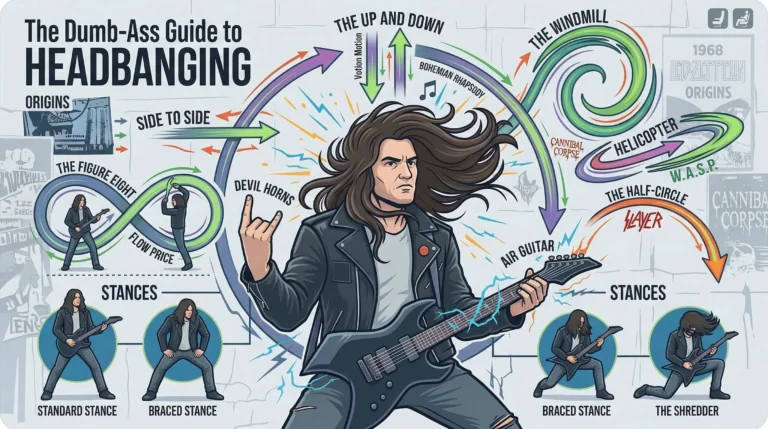
Dumbass Guide to Headbanging

5.22.2006 | blog, Madness, Music

Collected from various sources since some time, here it is… The Dumb Ass Guide to Headbanging!

The term “headbanger” was coined on Led Zeppelin’s first US tour in 1968. During a show at the Boston Tea Party audience members in the first row were banging their heads against the stage in rhythm with the music.

Headbanging is a type of dance which involves violently shaking the head in time with music, most commonly heavy metal music. It is most visually effective when the person headbanging has long hair.

There are various styles of headbanging, including:

* The up and down – Which involves shaking the head up and down – This style is demonstrated at the climax of the “Bohemian Rhapsody” scene in the movie Wayne’s World.

* The circular swing (Windmill) – Swinging the head in a circular motion – This style is more commonly known as the Windmill or Helicopter. Popularized by Blackie Lawless of W.A.S.P. and George “Corpsegrinder” Fisher of Cannibal Corpse. This style is often used by members of Amon Amarth and many other bands.

* Drunken Headbanging – A form of head banging in random directions, like the person is drunk, often people lose their balance and fall over. Bands such as Immortal are a good example of this.

* The half-circle – Swinging the head repeatedly from side to side in a downward arc: this style is often used by Tom Araya of Slayer.

* The figure eight – Which involves shaking the head in a figure eight.

* The side to side – Which involves shaking the head from side to side, whipping the hair on each transition. This style is used by Alexi Laiho of Children of Bodom, Mick Thompson of Slipknot (during the “build-up” moments of a song) Martin Mendez of Opeth, and Metallica bassist Robert Trujillo.

* The whiplash – An especially violent form of the traditional “up and down” style, characterized by the hair of the handbanger moving about so rapidly that it obscures their face. This style possibly pioneered by AC/DC guitarist Angus Young, and also used by Mick Thomson of Slipknot and late Metallica bassist Cliff Burton.

* The all-out – The most insane form of all, often involving dropping on the ground, holding oneself up with his or her arms, and violently swinging the head between the arms. This style sometimes involves grabbing onto tables and other fixed objects to hold the headbanger up, as their head movements have become so violent they seriously affect balance.

* The tandem – Judas Priest guitarists K.K. Downing and Glenn Tipton pioneered and perfected a tandem form of headbanging in which they stand side by side and headbang in unison. (See also Wolf Hoffman and Jörg Fischer of Accept.)

* The asshole – A rather inconsiderate form of headbanging where the person violently swings forwards and backwards from their waist, often headbutting people in front of them, or in more extreme circumstances, behind them.

* The low-profile - A variation on the “The up and down” where the performer’s headbanging movements are short and more subtle, but still noticeable.

Various styles are often mixed together according to taste and to the tempo and aggression of the music. In practice, they can also be performed with eyes-closed and/or in combination with hand gestures such as devil horns and/or singing, yelling, or lip syncing. Headbangers’ bodies usually bang with the head, reducing the strain on the neck and making the body move in a serpentine, up-and-down fashion to the music. There are a number of different stances a headbanger can stand in, which include:

* Standing up straight. This is most commonly performed with the legs slightly apart, mainly to keep balance.

* Standing with the legs slightly bent and the hands on the knees or thighs. This is a common stance for headbangers performing the half-circle, as it allows maximum movement and balance.

* Standing with the hands behind the back.

* Standing with one leg in front and one behind, with the hands held together near the lower body. This style is often used in tight spaces or to alleviate cramp and maintain balance.

* Standing with legs extremely stretched to the front and back of the body, lowering the head and body as low as possible to avoid loss of balance, while shredding an Air guitar, usually with the hand holding the guitar neck placed on the according knee and the other one lowered to “pick the strings”.

Alternatively, a headbanger can also perform while seated, crowd surfing, or in a number of other positions.

Honorable headbangers
(3 Slayer members!)

* Tom Araya
* K.K. Downing
* Jeff Hanneman
* James Hetfield
* Kerry King
* Scott Ian
* Glenn Tipton
* Mick Thompson
* Dimebag Darrell
* Per Wiberg
* Angus Young
* Mark G.
Be Warned!!!

Health issues

In practice, headbanging is considered much safer than moshing and has hardly any short-term side-effects. Unsafe practice, such as headbanging while intoxicated, under the influence of narcotics, or too close to someone else, is the common cause of injury, also known as a bangover. In 2002, Jason Newsted claimed his departure from Metallica was partly due to wear of the cartilage in his neck, but this is the only known case of long-term physical damage as an alleged result of headbanging.

Practice Safe Headbanging!

Stay tuned for Dumb Ass Guide to Metal, coming soon….

\m/

Tags:


Heartwork: A Taste of Carcass

5.18.2006 | blog, Music

Works of art, painted black
Magniloquent, bleeding dark
Monotonous palate, murky spectrum, grimly unlimited
Food for thought, so prolific
In contrasting shades, forcely fed
Abstraction, so choking, so provocative

Carcass – Heartwork

Track listing
1. Buried Dreams
2. Carnal Forge
3. No Love Lost
4. Heartwork
5. Embodiment
6. This Mortal Coil
7. Arbeit Macht Fleisch
8. Blind Bleeding the Blind
9. Doctrinal Expletives
10. Death Certificate

Lineup:
Jeff Walker (bass & vocals)
Ken Owen (drums)
Bill Steer (lead guitar)
Michael Amott (lead guitar)

Colin Richardson – Producer
Keith Andrews – Engineer
Andrea Wright – Assistant Engineer
Dave Buchanan – Assistant Engineer

Carcass, carcase [kaarkas]
n dead body of animal; trunk of dead animal after head, limbs, and offal have been removed by a butcher;
(cont) body of human being;
Liverpool based band of grinding musicians sharing an unhealthy interest in the macabre.

In my previous posts I was talking about Gothenberg and the melodic metal references, well continuing on that is this revisiting one of my all time favourite albums of all time!

Melodic metal?
This is where it all started. This very album could be termed as the first melodic metal album.

Consider this, a grindcore metal band that was responsible for creating that genre along with Napalm Death signs up with Columbia label and records an album in 1993 far removed from the gore obsessed themes of previous releases but a totally new sonic territory that would become a template for many bands nearly a decade later.

Ring a bell? Right. This is the year that witnessed so many metal releases under big labels.

This is not an album that anyone could have expected from Carcass, previously a band obsessed with writing songs about forensic or psychopathological themes like the kind of fun you can with a rotting corpse with its puss laden guts coming out or the way various parts of a rotting corpse could be used to grow plants.

Interesting?
Yes, in a peculiar Carcass kind of way.

Carcass was a Liverpool based British band formed in 1985 by ex-Napalm Death guitarist Bill Steer with drummer Ken Owen. Soon they were joined by a mysterious singer of Indian origins called Sanjiv who recorded a demo tape called as ‘Flesh Ripping Sonic Torment’.
Sanjiv was replaced by Jeff Walker (ex-Electro Hippies) in 1987.

Carcass started as goregrind band with lyrical content dripping in medical themes (which the press believed that most of them possessed a degree in medicines or something, which obviously the band members didnt), complex harmonies. Carcass could easily be the most amazingly talented and original metal bands you might have come across.

Carcass still today is considered as one of the best death metal bands of all time. By the way, later Swedish guitarist Michael Amott (ex-Carnage) gave birth to Arch Enemy after he departed from Carcass after Heartwork was released.
It is interesting to note that every exit is marked by another entry (think of Six Feet Under as well in this context).

Where as many bands in the noisy genre seldom innovate or challenge themselves, Carcass tread a different ground with each of their releases.
By the time they had released their 3rd album ‘Necroticism – Descanting the Insalubrious’ (1991) on Earache Records, the metal crowd and the critics had pretty much come to a conclusion that Carcass is not ‘just-another-noisy-metal-band’.

Their earlier records had the lyrical content that could not be translated using a standard dictionary, for that
you would have to possess a medical dictionary or something. Morbidly humourus ‘Spinal-Tap-goes-to-med-school’ lyrics, blistering, complex drumming, light speed solos and demonic, insectile vocals.

Carcass has dabbled into almost every major genre of death metal at the same time defining some of them like grindcore (goregrind), melodic death metal, thrash (as on Swansong) and so on.
Their debut album was badly produced but got wide acceptance in metal underground, the next one Symphonies of Sickness was a step further in production quality and brutal sonic assault.
3rd album ‘Necrotism – Descanting the Insalubrious’ released in 1991 was their best featuring some of the groovy metal numbers like “Corporal Jigsore Quandary”, “Simposium of Sickness” and “Incarnated Solvent Abuse” was an instant success and cemented their reputation as a brutal grindcore metal band.

Around this time they had become a metal household name, Columbia thought it was a good idea in the history of good ideas and signed Carcass for a 4 million dollar recording deal…

Their best was yet to come.
There is a major debate over which one is the best album by Carcass, it all depends on how you discovered Carcass into your consciousness. Some people swear by Necrotism or Swansong as the best Carcass record where as most of them refer to Heartwork as their best effort.

Better still gather a group of Carcass fans and note down favourite Carcass album list of each of the fans, dont be surprised if you get all different ones right from their debut album to Swansong (yes, their final album was called as that).

I’ll give you the pointers why Heartwork is worthy of that place.

By all standards, Heartwork is one of the monumental classic death metal records of all time, any list without this record is a bloody waste.

“Call yourself a metalhead and havent heard this album? Go suck an egg!”, said one columinst in a magazine where I used to get my metal dope on.
Well I’ll be buggered if it aint true!

Before I listened to Heartwork, I came across Carcass only once when a friend of mine had a battered piece of cassette of ‘Symphonies of Sickness’, it was way back in 1994 and I was more into Hendrix and stuff so that particular album was too much of sonic assault on my unsuspecting ears. Eventually I heard it once and steered myself away from it for a while.

Then it was in 1997, I found Heartwork album at a friend’s place and thought I’d give it shot after 4 years it was released. Instead I was shot back!

This was not at all the Carcass I had witnessed earlier. Gone are the gore obsessed lyrics, rotting corpses, medical themes and stuff, in turn they were replaced by Jeff Walker’s nihilistic attitudes directly reflected in some songs and even though the lyrics are simple and straight without requiring a dictionary to be kept handy (know-what-i-mean?) at times elevate to the level of beautiful poetry like as on ‘Blind Bleeding the Blind‘ is an interesting take with references to Shakespeare’s murder tale MacBeth.

Parched with thirst our cup overfloweth
With the crimson milk of human blindness
In charnel towers of ivory besieged
The bones of subjugation are picked clean
In barren decadence, tears are the only affluence
Welling eyes are indifferent, as the blind bleed

The album kicks off with a brilliant number called as Buried Dreams, slow doomy riffs that later make way grinding rhythm parts and excellent drumming and not to mention this is one of the best opener songs of any album i had known or heard before.

“Welcome, to a world of hate
A life of buried dreams
Smothered, by the soils of fate
Welcome, to a world of pain
Bitterness your only wealth
The sand of time kicked in your face
-Rubbed in your face”

These are the opening lines of Heartwork album as it kicks in, few seconds into the song you’ll realise that you are not in the same sonic territory as Necrotism or any of their previous records, it is that obvious.
Even the cover art is a radical departure from the previous or the latter ones, hardcore fans shouted “sellout” since it was the band’s major label release from a 4 million dollar contract with Columbia. But the major label
hadnt done anything to the sound and integrity of the band except the lyrical content dropping their excessive bloody details!

This album does not contain any fillers at all. The best metal album ever recorded that deserves more recognition and wider audience than bozo bands like Limp Bizkit, Linkin Park and their ilk.
The new generation of metallers who are into shiny metal bands havent heard of Carcass or havent heard their songs, not to blame them. Music channels feed crap and dont believe what they say is cool, they are not informing you but brainwashing you to believe what they are trying to create a market for 18-25 demographic.

There is no band like Carcass or there can be any band like it.
Thank god that there is Carcass at least. I am not complaining for that at least!

Heartwork is an infectiously groovy, catchy, melodic and yet retaining unquestionably brutal sonic assault that Carcass was well known for.
I wont say anything about the twin guitar assault of Amott / Steer duo or the thunder, intricate, captivating drumming of Ken Owen (incidentally he is the most underrated drummers in metal), you gotta listen to it once to appreciate it. Actually this album features many lengthy solos as well as longer song durations, beautiful solos laid over slow, technical and insanely heavy riffs.
Jeff Walker (Bass, Vocals) has a demonic, insectile voice that fits perfectly, he is original and distinctive, far removed from the cookie monster growls of many death growlers.
He is really original in terms of singing, accessible rasping vocals that add undeniable demonic, sinister quality. Very demonic snarl delivering listener friendly lyrics.

This is where it all started, Carcass had managed to record the first and finest melodic death metal as we have come to know it now. This was the template which left many disciples to follow and evolve the genre.
Never outgunned or surpassed, this still stands out as the best melometal album of all time. Period.

Accessible. Bloody heavy.

Where are they now?
The band that never followed even what they created and refusal to be predictable led them to a stage where they either disintegrate or breakthrough (immediately Cynic comes to my mind, of which I’ll write soon).
Here the villain was not the creative differences or any other stupid reasons that made Max Cavalera got fired from Sepultura, it was something else.

Swansong was their last album and a certain record company screwed them big time, their album was delayed by a year for release, founding members Bill Steer and Ken Owen walk out and as the things go, Carcass is no more.

Here are some pieces from an interview with Carcass members when they were asked about the label issues, it sums up the attitude the band had in terms of music and business.

“What morality’s involved? There’s not much difference between indies and majors at the end of the day, except major labels are probably more brutal than an indie at screwing bands up!”

“Independent music was bought out a long time ago! Most indies now have links with EMI, or Sony – and you can rag on a major label all y’like, but the music isn’t gonna sell out or go commercial! We’re not gonna try and water it down, and that’s all that matters. We’ve still got the same mentality.”

Occasional compilations like Choice Cuts, Wake Up And Smell The Carcass are released by their previous record companies which by any means are better deals for anyone who is going headfirst into Carcass sonic territory and also for a hardcore Carcass fan since they include some of the outtakes or alternate versions of classics as we have come to know them.

Carcass was the kind of a band that would call it a day than compromise on the integrity of the band in terms of values, attitude or the musical direction of the band.

After Carcass was dissolved it made way for some interesting projects since grindgore metal with psychopathological themes was too limited.

Arch Enemy owes its birth to Mike Amott, incidentally the Enemy album Stigmata sounds like an extension of
Heartwork, which is not a bad thing. Who’s complaining?
Arch Enemy has established a name for itself as a force to reckon with in a scene filled with mindless metal
releases over the years earlier (Angela Gossow, the lead female vocalist of Arch Enemy is the kind of babe who’d make you “wanna-sleep-with-the-Enemy”, get a load of her screaming her guts out, you’ll know what I mean, forget the goth females and all).

Ken, Jeff and Carlo continued with the Blackstar project accompanied with former Cathedral bassist Mark Griffiths. Blackstar (later Blackstar Rising) went defunct after Ken suffered from a severe brain haemorrhage. Recently he returned totally recovered, fine and dandy for the remastering of Choice Cuts, a fine compilation released by Earache Records (if you are new to Carcass, start from this album and then slowly you can indulge in individual albums to get a “taste of Carcass“).

Bill Steer and Jeff Walker have formed ‘Firebird’, a country / blues band with songs of John Denver , Johnny Cash and George Jones covers with a metal angle with guests musicians from bands like Amorphis, Napalm Death and Faith No More.
Check out their single “Youre still on my mind” written by Country legend George Jones, google it and you’ll find a place to listen to it. It’s a brilliant piece.

Some unusual info on Carcass:
The sculpture depicted in the cover art, “Life Support 1993″, was designed by H.R. Giger. The video for the song “Heartwork” features the sculpture.

Carcass tunes their guitars down 2 and a half steps, ending up like this (low-high): B E A D G F# B. Jeff tuned his bass to standard concert pitch, with the low E string de-tuned to B.

Bill Steer used to also play for Napalm Death, appearing on their first 2 albums (Scum and From Enslavement to Obliteration) as well as Death by Manipulation.

Carcass’s record label was Earache Records. That other company will not be mentioned by name or discussed.

On the Indie Metal chart, Carcass were second with Heartwork (Sepultura’s Chaos A.D. was first)

How to close this post?

I dont know, I’ll never come across a band like Carcass. Period.

\m/

Tags: , ,


1 pages